
Well-Established and Respected Educational Philosophies
These are all unique systems and approaches that have developed across decades and across generations. It is our belief that the main ideas compliment more than clash with one another, at minimum provoking deep thought about what values we set our daily practices on. The core commonality is that children thrive when they are respected as individuals, given opportunities to explore their capabilities, and supported by thoughtful adults who understand that experiences are both shared while remaining unique to the individual.
-
Outdoor learning is a central feature of the program, with frequent, regular opportunities for outdoor play and learning in natural spaces.
Teachers and children are dressed appropriately for the weather, and teachers demonstrate positive attitudes about experiencing various weather conditions.
Teachers develop and maintain teaching materials designed or adapted for outdoor use.
Children’s interests and abilities direct learning opportunities and assessment.
Teachers emphasize opportunities for individualized learning across learning environments.
Children’s inquiry is used to encourage higher-order thinking, and the inquiry process is allowed to continue for as long as children’s interest remains.
Teachers provide a daily routine that allows for flexibility.
Teachers are co-learners with children
Teachers provide opportunities for child-child interactions to promote collaboration and conflict resolution.
Teachers provide an environment that values diversity and sustains children’s cultural identities.
Children’s progress in both standard early childhood developmental domains and domains that relate to the development of environmental literacy are included in assessment measures.
Teachers engage children in documenting their own individual and group learning so children can process and reflect on their own learning over time.
-
The children are active participants and decision makers in what, when, and how to study. It is up to adults to follow and plan accordingly. Artistic expression is at the heart of the Reggio approach. A child’s art is considered valuable communication that is studied with care. Teachers consider that collaborative problem solving among children and between children and adults is important. Spaces for individual study (ateliers, “àtt’l yáy”), as well as small-group and total-group activities, are provided.
Staff members keep records (diarios) of the children’s work, communications, and their own analyses for parental and administrator preview.
-
In this highly creative model of education, early childhood classrooms are routinely abuzz with dialogue, storytelling, building, painting, creative fantasy play, and representation of individual knowledge and experience, with the goals of social renewal and strengthening society. The heart of Rudolf Steiner’s early childhood practice is focused on teacher-child relationships. Waldorf teachers achieve strong bonds with children.
Steiner firmly believed that children need to focus their energies on developing their physical bodies and imagination during their early years. He strongly cautioned against pushing children’s development of intellectual skills.
He further explained that the child’s innate intelligence of his or her developmental needs and energy to work on those needs must not be “siphoned off too early from this essential task [physical development] into intellectual learning. Therefore, in the Waldorf Kindergarten no academic instruction takes place. Instead, children’s imaginative play in a carefully crafted environment serves as the foundation for later academic knowledge and skill-building.
-
“It is the sin of the soul to force young people into opinions…but it is culpable neglect not to impel young people into experiences.” – Kurt Hahn, German educator. His core philosophy was to impel youth into intense physical and moral challenges to build resilience, compassion, and a commitment to civic service. Experiences that challenge reveal inner strength and conquers self-doubt.
For Hahn, growth is emotional and moral—the individual faces a physical or psychological limit, pushes through it with a team, and develops empathy and grit.
At Ginkgo Blue, we believe children need opportunities to encounter manageable challenges, take appropriate risks, solve problems, and experience the satisfaction of accomplishing something difficult. Whether navigating uneven terrain, building a shelter, working through a disagreement, or learning to use tools, children develop confidence by discovering what they can do.
-
Experiential learning does not end when an activity is complete. The experience becomes more meaningful when children have opportunities to reflect, make connections, develop new ideas, and apply what they have learned.
David Kolb described the ideal process of learning in a four-step Experiential Learning Cycle:
Experiencing (engage in what is happening)– Reflecting (connects feelings with ideas about the experience) – Thinking (theorize and conceptualize to test and reach conclusions) – Acting (test theories and apply what was learned to help create next experience).
The Kolb Educator Role Profile shows that every exceptional experiential educator moves among four roles: Facilitator, Expert, Evaluator, and Coach. Each role serves a different purpose and links to two of the learning modes. The real impact comes from knowing when to support, when to challenge, and when to step back so learners build confidence and capability. -
Instilling in each child a reverence and respect for themselves, each other, and their environment is one of our most important tasks as teachers. A big part of each day is spent working on self-care skills and also work that takes care of this space. Children should be allowed to work at self-selected activities with little interference from teachers. Dr. Maria Montessori believed that children come into this world with a natural sense of spirituality, inquisitiveness, capability, and purpose, all of which act as driving forces in their development and learning.
A great deal of her writing chronicled her belief that the “secret of childhood” was that children, when unfettered by inappropriate adult demands, would naturally and spontaneously engage in activities that guided their development toward becoming ordered, productive adults. According to Montessori, development is an internally regulated process that requires carefully planned interaction with the environment and materials. She wrote passionately about her belief that children’s development was strongly influenced by their environment and experiences as well as by their internal drives (Goffin, 1994). It was important to cultivate a psychological space in which children were respected and free. In this way, there would be a great deal of individualization to children’s learning.
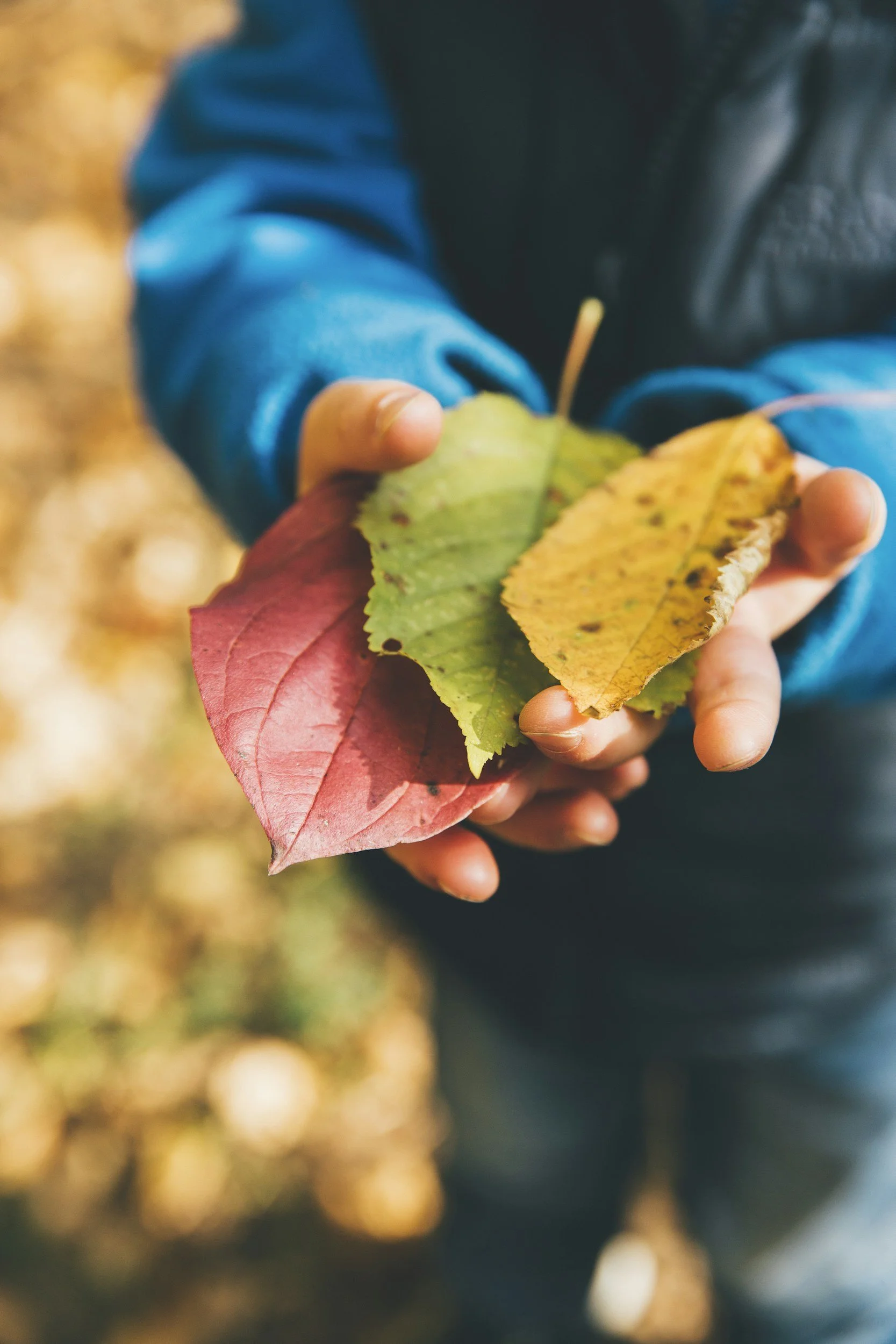
Outdoor Activities
Children thrive when they are respected as individuals, given opportunities to explore their capabilities, and supported by thoughtful adults. It is our belief that environment plays a much bigger role in the child's learning experience than we give it credit.
Here’s a list of some of our activities:
loose parts play with natural materials such as leaves, rocks, sand, water, pinecones, animal bones, etc.
provocations or invitations where a spot is set up for each child with planned materials and freedom to explore those materials
sports at an introductory level with age-appropriate rules and team play
story time: reading books, oral stories, dramatic and imaginative
sit spots and spaces for individual study (ateliers)
yoga and breathing exercises
music time with ukuleles and percussion
art in various forms with sometimes messy, natural mediums that are safe and age-appropriate
nature journals which each child will create to document our daily experiences in a way that's uniquely fun for each of them
learning to use tools like potato peelers and cheese graters, wrenches and saws (all kid-sized)
various dexterity and fine-motor skill crafts
cleaning and organizing our spaces
outdoor expeditions